Every founder I’ve talked to asks the same question sooner or later: what’s the actual process for company registration in India, and how long does it realistically take? The government portals make it sound like a quick online form, but there’s more nuance to it than that.
Let’s go through company registration in India the way it actually plays out — not the marketing-brochure version.
What Type of Company Should You Register?
Company registration in India generally falls under a few main structures — Private Limited Company, One Person Company (OPC), Limited Liability Partnership (LLP), and Sole Proprietorship — each suited to different business sizes and funding needs.
Most startups looking to raise investment go with a Private Limited Company, since VCs and angel investors typically prefer it. Freelancers or solo consultants often choose OPC or stay as sole proprietors, at least initially.
Step 1: Obtain Digital Signature Certificate (DSC)
Everything today runs through the MCA (Ministry of Corporate Affairs) portal, and that requires a Digital Signature Certificate for all proposed directors. This usually takes 1-2 days and costs somewhere between ₹1,000 to ₹2,000 per person, depending on the certifying agency.
Step 2: Apply for Director Identification Number (DIN)
Each director needs a unique DIN, which is now typically applied for along with the incorporation form itself (SPICe+) rather than as a separate step, which has genuinely sped things up compared to a few years ago.
Step 3: Name Reservation
You’ll need to reserve your company name through the RUN (Reserve Unique Name) service or as part of SPICe+ Part A. Pro tip: have at least two or three backup names ready, because rejection due to similarity with existing names or trademarks is more common than people expect.
Step 4: File SPICe+ Form
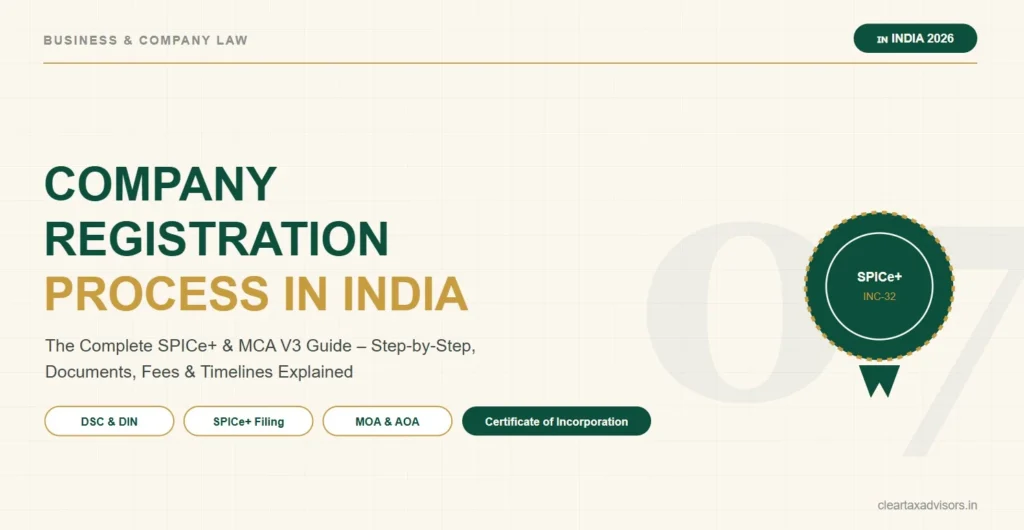
This is the core incorporation form, and it’s genuinely a “one-stop” filing now — it combines company incorporation, DIN allotment, PAN, TAN, EPFO, ESIC, and even bank account opening in many cases. It wasn’t always this integrated, and I’ll admit, it’s one government reform that actually made life easier.
Step 5: Draft MOA and AOA
The Memorandum of Association (MOA) defines the company’s objectives, while the Articles of Association (AOA) lays out internal rules and governance. These need to be drafted carefully — vague objective clauses can cause problems later when you want to expand into new business areas.
Step 6: Certificate of Incorporation
Once the Registrar of Companies (RoC) approves everything, you get the Certificate of Incorporation, along with your Corporate Identification Number (CIN). This is your company’s official birth certificate, legally speaking.
Realistic Timeline and Costs
- DSC: 1-2 days
- Name approval: 1-2 days (longer if rejected and resubmitted)
- SPICe+ filing and approval: 5-10 working days typically
- Total time: Usually 10-15 days if everything goes smoothly, though I’ve seen it stretch to a month when documents are incomplete or there are name objections
Government fees vary by state and authorized capital, but for a small private limited company, total costs including professional fees often range from ₹8,000 to ₹20,000.
[link to related guide comparing LLP vs Private Limited Company here]
Documents You’ll Need
- PAN card of all directors
- Address proof (Aadhaar, passport, voter ID)
- Passport-size photographs
- Proof of registered office address (rent agreement/utility bill)
- NOC from the property owner, if rented
Post-Registration Compliance
Registration isn’t the finish line — it’s the starting gun. After incorporation, companies need to open a bank account, appoint an auditor within 30 days, and start maintaining statutory registers. Skip these, and penalties pile up quickly.
FAQs
Q1: How long does company registration take in India? Typically 10-15 working days if all documents are in order, though delays with name approval or document mismatches can push it further.
Q2: What is the minimum capital required to register a company in India? There’s no minimum paid-up capital requirement anymore for private limited companies — you can technically start with as little as ₹1, though most founders set a more reasonable working capital.
Q3: Can a foreigner be a director in an Indian company? Yes, foreign nationals can be directors, though at least one director must be an Indian resident (someone who’s stayed in India for a specified number of days in the previous year).
Q4: What’s the cost of registering a Private Limited Company? Costs generally range from ₹8,000 to ₹20,000 including government fees and professional charges, depending on authorized capital and the state.
Q5: Do I need a physical office to register a company? You need a registered office address, but it doesn’t have to be commercial space — a residential address can work as long as you have proper proof and NOC.
Wrapping Up
Company registration in India has genuinely improved over the last few years with SPICe+ and integrated filings, but it still rewards careful preparation. Get your documents right the first time, pick your entity type based on actual business needs (not just what sounds impressive), and you’ll save yourself a lot of back-and-forth with the RoC.
Suggested image alt text: “Entrepreneur completing company registration process India on laptop” Suggested image alt text: “MCA SPICe+ form for company registration in India”