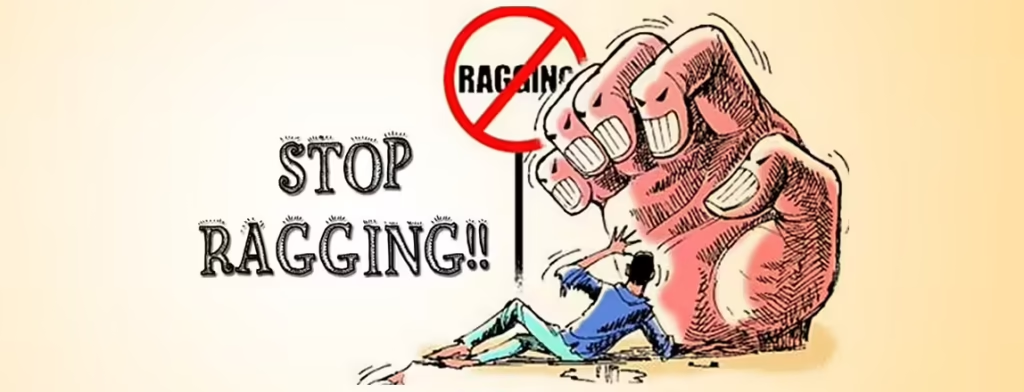
Every year, right around admission season, there’s a fresh round of ragging incidents reported in the news — some minor, some genuinely tragic. What most students and parents don’t realize is just how much legal protection actually exists under anti-ragging law in India. It’s not vague or toothless; it’s actually fairly robust on paper, even if enforcement varies from campus to campus.
Let’s go through what the anti-ragging law in India actually says and, more importantly, what to do if you or someone you know is affected.
What Legally Counts as Ragging?
Under UGC Regulations 2009 and various state anti-ragging laws, ragging includes any act — physical, verbal, or psychological — by a senior student that causes embarrassment, fear, or harassment to a junior, whether done directly, in a group, or even through indifference and negligence toward a junior’s discomfort.
That definition is broader than most people assume. It’s not just physical abuse — forcing someone to do embarrassing tasks, verbal humiliation, or even persistent teasing that causes distress can legally qualify.
Where Does the Law Come From?
There isn’t one single national statute called the “Anti-Ragging Act.” Instead, protection comes from a combination of:
- UGC Regulations, 2009 (Curbing the Menace of Ragging in Higher Educational Institutions)
- State-specific anti-ragging laws (many states like Tamil Nadu, Kerala, and others have their own dedicated legislation)
- Supreme Court directives, particularly following the landmark Vishwa Jagriti Mission v. Central Government case, which led to the formation of anti-ragging committees nationwide
What Every College Is Required to Do
Colleges aren’t just encouraged to prevent ragging — they’re legally mandated to:
- Form an Anti-Ragging Committee and an Anti-Ragging Squad
- Collect anti-ragging affidavits from every student and their parents at admission
- Display anti-ragging helpline numbers prominently on campus
- Conduct regular sensitization programs, especially in the first few weeks of the academic year
The National Anti-Ragging Helpline
Students can call 1800-180-5522 (a toll-free, 24×7 helpline run by the UGC) to report ragging incidents. Complaints can also be filed on the official antiragging.in portal, which routes the complaint directly to the concerned institution and the UGC simultaneously.
What Punishments Can Be Imposed?
Punishments for ragging can be severe, and colleges are required to act, not just issue a warning:
- Suspension or expulsion from the institution
- Withholding of scholarships or fellowships
- Debarment from appearing in examinations
- Rustication for a specified period
- In serious cases, criminal prosecution under IPC/BNS provisions for hurt, criminal intimidation, or even outraging modesty, depending on the nature of the act
Can a Ragging Victim File a Police Complaint?
Yes, absolutely — and this is important. Anti-ragging measures within the college don’t replace the right to file an FIR. If the ragging involves physical assault, sexual harassment, or serious threats, students can and should approach the police directly, in addition to reporting to the college committee.
[link to related guide on RTE Act 2009 here]
A Real Scenario
Picture a first-year engineering student forced by seniors to run errands, perform humiliating tasks in front of classmates, and skip meals as “punishment” for refusing. This clearly falls within the legal definition of ragging, even without physical violence. Reporting it — to the anti-ragging committee, the helpline, or police if needed — isn’t “overreacting.” It’s exactly what the law exists for.
Why Enforcement Still Falls Short Sometimes
Here’s my honest take: the law itself is fairly comprehensive, but implementation varies wildly by institution. Some colleges take it seriously with genuine sensitization programs; others treat the anti-ragging affidavit as a formality to be signed and forgotten. Students and parents shouldn’t assume protection just because a policy exists on paper — actually knowing the helpline number and reporting process matters.
FAQs
Q1: What is the punishment for ragging in Indian colleges? Punishments range from suspension and expulsion to withholding of scholarships and, in serious cases, criminal prosecution under applicable penal provisions.
Q2: Is verbal or psychological ragging punishable, or only physical ragging? Yes, both verbal and psychological ragging fall within the legal definition and are punishable, not just physical acts.
Q3: What is the national anti-ragging helpline number? The toll-free helpline is 1800-180-5522, operating 24×7, run by the UGC for reporting ragging incidents anywhere in India.
Q4: Can I file both a college complaint and a police FIR for ragging? Yes, these are independent processes — reporting to the college’s anti-ragging committee doesn’t prevent you from also filing a police complaint.
Q5: Are anti-ragging laws applicable only to engineering and medical colleges? No, they apply to all higher educational institutions across India, regardless of the stream or type of college.
Final Thoughts
The anti-ragging law in India gives students genuine legal recourse — the problem has never really been a lack of law, it’s awareness and enforcement. If you or someone you know is going through this, don’t stay silent hoping it’ll stop on its own. Use the helpline, inform the committee, and involve the police if it escalates. The system, when actually used, does respond.