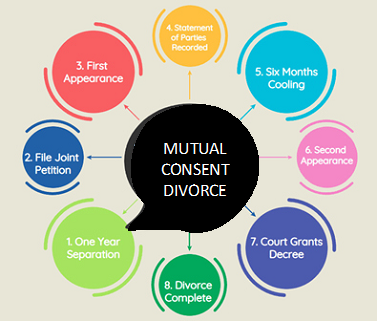
Deciding to end a marriage is hard enough without also having to decipher legal jargon about the mutual divorce process in India. I’ve noticed that most couples who come in for mutual divorce already know they want out — what they don’t know is how long it’ll take or what paperwork stands between them and a final decree.
Let’s clear that up.
What Is Mutual Divorce, Exactly?
Mutual divorce is a process under Section 13B of the Hindu Marriage Act (or corresponding provisions in other personal laws) where both spouses agree to end the marriage together, without blaming each other, making it faster and less adversarial than a contested divorce.
No allegations, no proving cruelty or desertion — just two people agreeing the marriage isn’t working.
Step 1: Draft a Settlement Agreement
Before filing, both spouses need to settle key issues between themselves — alimony, child custody, division of assets, and who keeps what. This settlement forms the backbone of the joint petition. Skipping this step, or being vague about it, tends to cause disputes later.
Step 2: File the First Motion Petition
Both spouses jointly file a petition before the family court, stating they’ve been living separately for at least one year and haven’t been able to reconcile. This is called the “First Motion.”
Step 3: The Six-Month Cooling-Off Period
This is where most people get confused about timelines. After the First Motion, the law provides a mandatory 6-month cooling-off period (extendable up to 18 months) before the Second Motion can be filed — the idea being to give couples one last chance to reconsider.
Under Section 13B(2), the mandatory waiting period between the First and Second Motion is 6 months, though courts can waive it in genuine cases where reconciliation is clearly not possible.
Step 4: Waiver of the Cooling-Off Period
Following the Supreme Court’s 2017 ruling in Amardeep Singh v. Harveen Kaur, courts now have discretion to waive this 6-month period if it’s evident there’s no chance of reconciliation and all terms have already been settled. This has genuinely sped up a lot of mutual divorces in the last few years.
Step 5: Second Motion and Final Hearing
After the cooling-off period (or its waiver), both spouses appear again before the court for the Second Motion. The judge verifies that consent is genuine, not coerced, and that all terms of the settlement are being honored.
Step 6: Decree of Divorce
Once satisfied, the court passes the final decree, legally ending the marriage. From this point, both parties are free to remarry.
[link to related guide on child custody laws here]
Realistic Timeline
- Best case (with waiver): 2-3 months
- Standard case: 6-8 months
- With disputes over terms: Can stretch to a year or more
Documents Required
- Marriage certificate
- Address proof of both spouses
- Photographs
- Income and property details
- Evidence of separation (if available)
- Settlement agreement covering alimony and custody
FAQs
Q1: How long does the mutual divorce process take in India? It typically takes 6-8 months, though it can be shortened to a couple of months if the court waives the mandatory cooling-off period.
Q2: Can mutual divorce be filed without a lawyer? Technically yes, but given the documentation and court procedure involved, most couples find it far smoother with legal assistance.
Q3: Is the 6-month waiting period compulsory in every case? No, courts can waive it under specific circumstances, particularly following the Amardeep Singh judgment, if reconciliation seems genuinely impossible.
Q4: What happens if one spouse withdraws consent midway? If either spouse withdraws consent before the Second Motion, the mutual divorce petition fails, and the case would need to proceed as a contested divorce instead.
Q5: Is alimony compulsory in mutual divorce? No, alimony is negotiated between the parties and isn’t mandatory — some couples mutually agree to waive it entirely.
Final Thoughts
The mutual divorce process in India is designed to be simpler than a contested divorce, but “simpler” doesn’t mean instant. Getting your settlement terms clearly documented upfront saves enormous time and conflict later. If both of you are genuinely on the same page, this route is almost always faster and less painful than the alternative.