Buying property is exciting, right up until you’re staring at a stack of documents wondering what actually needs to happen next. The property registration process in India is where the legal ownership actually transfers, and skipping or mishandling any step here can create headaches years down the line.
Why Registration Actually Matters
Property registration in India is the legal process of recording a property transaction with the government under the Registration Act, 1908, and until this is done, the buyer does not have legally recognized ownership, regardless of how much money has changed hands.
I can’t stress this enough — an unregistered sale, no matter how much you paid, doesn’t make you the legal owner in the eyes of the law.
Step 1: Verify Property Title
Before anything else, confirm the seller actually has clear, marketable title to the property. This means checking the chain of ownership documents going back at least 12-13 years, ideally 30 years for added safety, and confirming there are no pending disputes, loans, or encumbrances.
Step 2: Obtain an Encumbrance Certificate
This document, obtained from the Sub-Registrar’s office, confirms the property is free from legal or financial liabilities (like an existing mortgage). It’s one of the most important checks in the entire process — skip it, and you risk buying someone else’s problem.
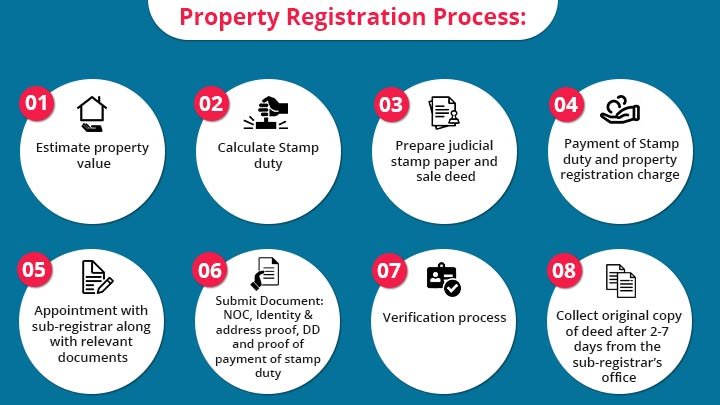
Step 3: Draft the Sale Deed
The sale deed is the primary legal document that transfers ownership. It must accurately describe the property, the sale consideration, and the rights being transferred. Errors here — wrong survey numbers, incorrect boundaries — can cause serious complications later.
Step 4: Calculate and Pay Stamp Duty
Stamp duty varies by state, typically ranging from 4% to 8% of the property’s market value or the transaction value, whichever is higher. In Rajasthan, for example, stamp duty rates differ for men, women, and joint ownership, with women often getting a concessional rate to encourage property ownership.
Step 5: Pay Registration Fees
Separate from stamp duty, registration fees are usually around 1% of the property value, though this also varies by state.
Step 6: Visit the Sub-Registrar’s Office
Both buyer and seller (or their authorized representatives) must be physically present at the Sub-Registrar’s office with two witnesses, original documents, ID proof, and photographs for biometric verification.
Step 7: Execution and Registration
The sale deed is signed, biometrics are recorded, and the document is officially registered. You’ll typically receive the registered document within a few days to a couple of weeks, depending on the state’s processing efficiency.
[link to related guide on checking property title before buying here]
Documents Required for Registration
- Sale deed (draft)
- Identity and address proof of both parties
- PAN card
- Property tax receipts
- Encumbrance certificate
- Passport-size photographs
- No Objection Certificate (if applicable, such as for society-owned property)
Realistic Timeline and Costs
Registration itself, once documents are ready, typically takes a single day at the Sub-Registrar’s office, though scheduling appointments and preparing documents beforehand can take 1-2 weeks. Total cost, including stamp duty and registration fees, often ranges from 5% to 9% of the property’s value depending on the state.
A Real-World Example
Picture a young couple buying their first flat in Jaipur worth ₹50 lakh. With Rajasthan’s stamp duty around 6% (with a slight concession if registered in the wife’s name), they’d budget roughly ₹3-3.5 lakh for stamp duty and registration costs combined — a figure many first-time buyers underestimate when planning their total budget.
FAQs
Q1: Is property registration mandatory in India? Yes, under the Registration Act, 1908, any property transaction above a certain value must be registered to be legally valid and enforceable.
Q2: How much is stamp duty on property registration in India? It varies by state, generally ranging from 4% to 8% of the property’s market or transaction value, whichever is higher.
Q3: What documents are needed for property registration? Key documents include the sale deed, ID proofs, PAN card, encumbrance certificate, property tax receipts, and photographs of both parties.
Q4: Can property registration be done online in India? Some states now allow partial online processes (document upload, appointment booking, e-stamping), but physical presence at the Sub-Registrar’s office is still required for final execution in most states.
Q5: What happens if a property isn’t registered? An unregistered property transaction isn’t legally recognized as a valid transfer of ownership, which can create serious disputes and complications later.
Final Thoughts
The property registration process in India might feel like a maze of paperwork, but each step exists to protect both buyer and seller from future disputes. Don’t cut corners here — verify the title thoroughly, budget properly for stamp duty, and make sure the sale deed is drafted with precision. It’s the difference between owning property and just holding a piece of paper.