When a medical procedure goes wrong — not because of unavoidable complications, but because of carelessness — families are often left wondering if they even have legal options. They do. Filing a medical negligence case in India is a well-established legal remedy, though it requires more than just a bad outcome to succeed.
What Actually Counts as Medical Negligence?
Medical negligence in India refers to a failure by a doctor or hospital to exercise the standard of care that a reasonably competent medical professional would provide under similar circumstances, resulting in harm to the patient — a bad outcome alone, without proven carelessness, does not automatically qualify.
This distinction matters a lot. Medicine involves inherent risk, and courts don’t punish doctors for complications that occur despite reasonable care.
The Bolam Test: India’s Legal Standard
Indian courts largely follow the “Bolam test,” established through English case law and adopted in Indian jurisprudence, which asks whether the doctor acted in a manner accepted as proper by a responsible body of medical professionals skilled in that field. If a reasonable body of doctors would have acted the same way, negligence typically isn’t established, even if the outcome was bad.
Where Can You File a Medical Negligence Case?
You actually have three possible routes, and choosing the right one matters:
- Consumer Forum (under Consumer Protection Act) — for compensation claims, this is often the fastest route
- Civil Court — for a broader claim of damages, particularly in complex cases
- Criminal Court — only in cases involving gross negligence amounting to criminal recklessness (Section 106 of the Bharatiya Nyaya Sanhita, formerly Section 304A IPC)
Most cases pursuing monetary compensation go through the consumer forum, since it’s generally faster and less procedurally complex than civil court.
Step-by-Step: Filing in Consumer Court
- Collect all medical records — treatment history, prescriptions, test reports, discharge summaries
- Get an expert medical opinion confirming that the treatment fell below accepted standards
- Calculate damages — medical expenses, loss of income, pain and suffering, future care costs if applicable
- File the complaint with the appropriate consumer commission based on claim value (District, State, or National Commission)
- Attend hearings, where both sides present evidence and expert testimony
How Much Compensation Can You Expect?
This varies enormously based on the severity of harm, the victim’s age and earning capacity, and the specific circumstances. Compensation in significant negligence cases in India has ranged from a few lakhs to, in landmark cases like the Kunal Saha v. Dr. Sukumar Mukherjee case, over ₹6 crore — though that remains one of the largest awards in Indian medical negligence history, not the norm.
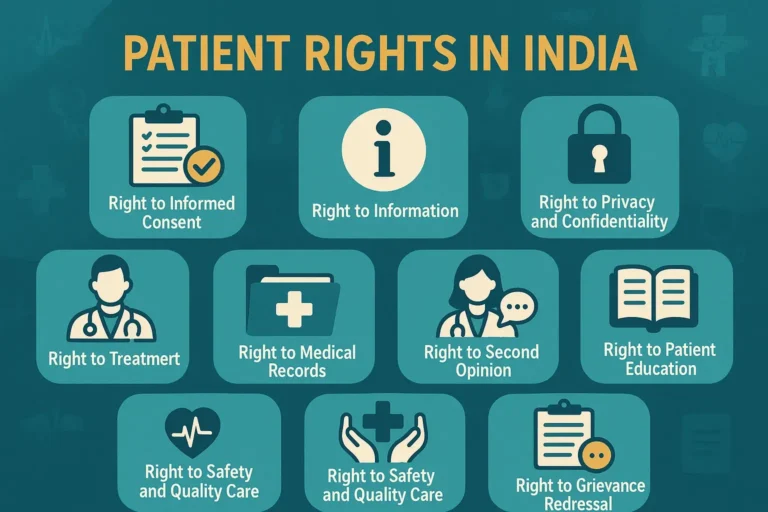
[link to related guide on patient rights in India here]
Why Expert Medical Opinion Is Critical
You genuinely cannot win a medical negligence case without expert testimony establishing that the treatment deviated from accepted medical standards. Courts and consumer forums rely heavily on this — a patient’s own dissatisfaction with the outcome isn’t legally sufficient on its own.
Common Mistakes That Weaken Cases
- Filing without securing complete medical records early (hospitals sometimes delay providing them)
- Not obtaining an independent expert opinion before filing
- Waiting too long — limitation periods apply here too, generally 2 years from the date of the negligent act or discovery of harm
- Focusing only on emotional distress without documenting actual financial and medical damages
A Real-World Example
Picture a patient who underwent a routine surgery and developed a severe infection due to unsterilized equipment, requiring three additional surgeries and months of recovery. With proper documentation — hospital records, an independent expert’s report confirming the infection stemmed from procedural lapses, and calculated financial losses — this becomes a strong, well-supported negligence claim.
FAQs
Q1: How long do I have to file a medical negligence case in India? Generally 2 years from the date of the negligent treatment or from when the harm was discovered, under the Consumer Protection Act.
Q2: Do I need an expert opinion to file a medical negligence case? While not always mandatory to file, it’s practically essential to win — courts rely heavily on expert testimony to establish deviation from standard care.
Q3: Can I file a medical negligence case against a government hospital? Yes, government hospitals and doctors aren’t exempt from negligence claims, though procedural nuances can differ slightly.
Q4: What’s the difference between filing in consumer court versus civil court? Consumer court is generally faster and focused on compensation, while civil court can handle more complex claims but often takes longer to resolve.
Q5: Is criminal action possible against a negligent doctor? Yes, but only in cases of gross negligence that goes beyond a simple lapse in care — ordinary negligence typically stays in the civil/consumer domain.
Final Thoughts
Filing a medical negligence case in India isn’t about punishing every disappointing outcome — it’s about holding genuinely careless treatment accountable. If you believe you or a loved one has experienced this, act quickly: secure records, get an independent expert opinion, and consult a lawyer experienced specifically in medical negligence claims.