If you’ve spent any time reading Indian court judgments, you’ve probably noticed one number keeps showing up again and again: 21. Article 21 of the Indian Constitution is arguably the most talked-about, most litigated, and most expansively interpreted provision in the entire document — and for good reason.
It’s just one sentence long. But that one sentence has been stretched by the judiciary to cover everything from privacy to a clean environment to the right to die with dignity. Let’s actually understand what Article 21 of the Indian Constitution says, and how it got this powerful.
The Actual Text
Article 21 of the Indian Constitution states: “No person shall be deprived of his life or personal liberty except according to procedure established by law.” That’s it — 20 words that have generated thousands of pages of judicial interpretation over the decades.
Why This One Sentence Matters So Much
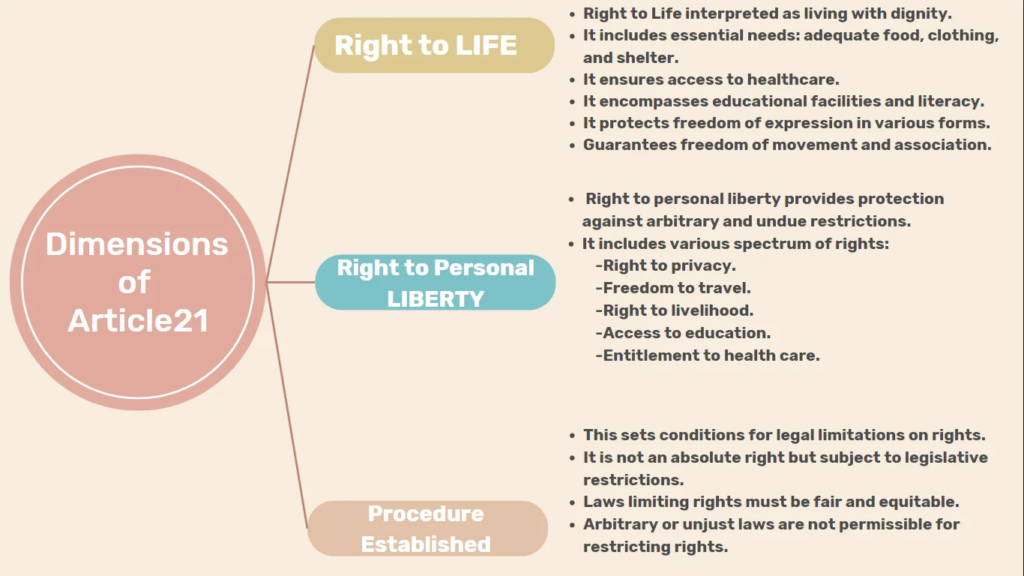
On paper, Article 21 sounds narrow — it just says the State can’t take away your life or liberty without following legal procedure. But the Supreme Court, particularly since the 1978 Maneka Gandhi v. Union of India case, has interpreted “life” to mean far more than mere biological survival. It now includes the right to live with dignity.
That single judgment changed everything. Before it, “procedure established by law” meant any procedure passed by the legislature was fine, however unfair. After Maneka Gandhi, the Court said the procedure itself must be fair, just, and reasonable — not arbitrary.
What Does “Right to Life” Actually Cover Today?
Over the decades, courts have read numerous rights into this single article. Some notable ones:
- Right to privacy (confirmed in the landmark 2017 Puttaswamy judgment)
- Right to a clean environment
- Right to livelihood
- Right to shelter
- Right to health
- Right to legal aid
- Right to speedy trial
- Right to die with dignity (in limited circumstances, recognizing passive euthanasia)
This is honestly one of the most fascinating things about Indian constitutional law — a single line has become a living, expanding umbrella for dozens of rights that aren’t explicitly written anywhere in the text.
Article 21 and Personal Liberty
The “personal liberty” part is just as important as “life.” It’s been interpreted to include freedom of movement, freedom from illegal detention, and protection against arbitrary arrest. If police detain someone without following due process, that’s a direct Article 21 violation, and courts take this seriously — habeas corpus petitions exist precisely for this reason.
Article 21A: The Related Provision on Education
Worth mentioning here — Article 21A, added through the 86th Amendment in 2002, guarantees free and compulsory education to children aged 6 to 14. It’s technically a separate article, but it grew directly out of the expansive reading of Article 21, since education was already being treated as essential to a dignified life even before 21A was formally added.
[link to related guide on RTE Act 2009 here]
A Practical Example
Picture a daily-wage construction worker in a small town whose employer refuses to pay wages for months, leaving the family unable to afford food or medical care. Courts have, in various cases, connected the right to livelihood directly to Article 21 — recognizing that without the means to survive, the “right to life” becomes meaningless. This is the kind of real-world weight this article carries.
Limitations: Is Article 21 Absolute?
No right is completely absolute, and Article 21 is no exception. The State can restrict life or liberty, but only through a fair, just, and reasonable procedure established by law — arbitrary or unreasonable restrictions won’t survive judicial scrutiny anymore, post-Maneka Gandhi.
FAQs
Q1: What does Article 21 of the Indian Constitution protect? It protects the right to life and personal liberty, guaranteeing that no person can be deprived of these except through a fair legal procedure.
Q2: Is the right to privacy part of Article 21? Yes, the Supreme Court’s 2017 Puttaswamy judgment confirmed privacy as a fundamental right flowing from Article 21.
Q3: Can Article 21 be suspended during an Emergency? No — unlike some other Fundamental Rights, Article 21 (along with Article 20) cannot be suspended even during a national Emergency, following the 44th Amendment.
Q4: What is the difference between Article 21 and Article 21A? Article 21 covers the broad right to life and liberty, while Article 21A specifically guarantees free and compulsory education for children aged 6-14.
Q5: Does Article 21 apply to non-citizens in India? Yes, Article 21 applies to “any person,” not just citizens, meaning foreign nationals in India are also protected by it.
Final Thoughts
Article 21 of the Indian Constitution started as a simple due-process clause and evolved into the backbone of individual dignity in Indian law. In 2026, as courts continue applying it to new areas like digital privacy and data protection, its scope is still growing. It’s one provision worth actually understanding, not just memorizing.
Suggested image alt text: “Supreme Court of India building representing Article 21 rights” Suggested image alt text: “Gavel and Constitution of India book open to Article 21”