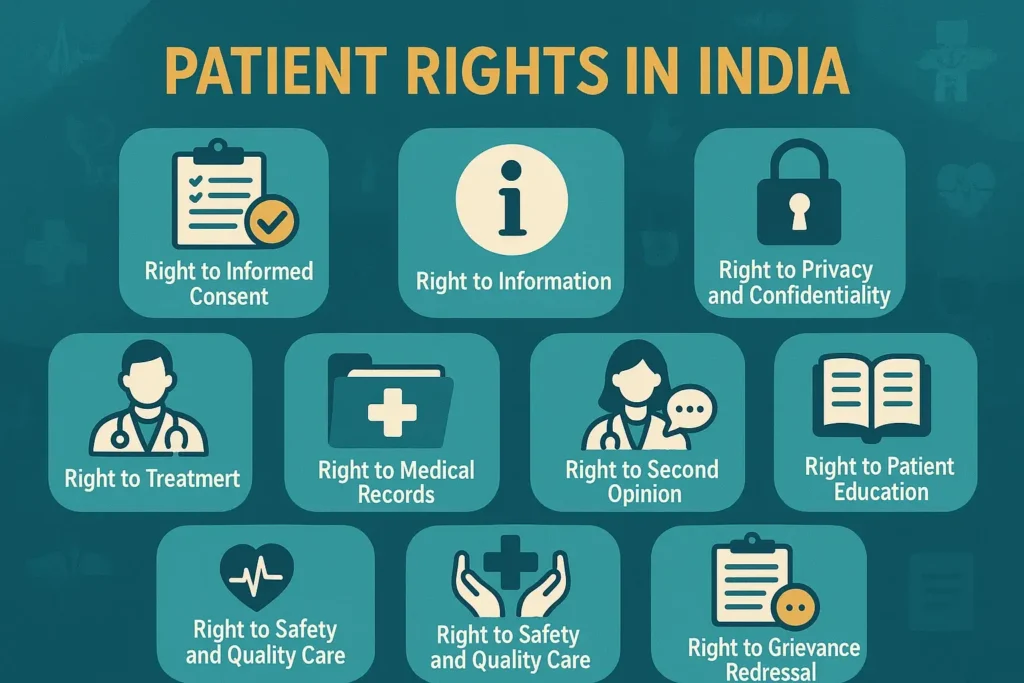
Most people walk into a hospital assuming they have no real say in what happens next — they just sign whatever’s put in front of them and trust the process. But patient rights in India are more substantial than most people realize, and knowing them can genuinely change how you’re treated during a medical crisis.
The Legal Foundation for Patient Rights
Patient rights in India stem from a combination of the Consumer Protection Act, the Indian Medical Council (Professional Conduct) Regulations, and judicial precedents that treat medical negligence as a civil wrong, giving patients the right to informed consent, quality care, and legal recourse for negligence.
There isn’t one single “Patient Rights Act” at the national level (though the National Human Rights Commission published a Charter of Patient Rights in 2019 that many states have adopted), but the protections exist across multiple laws.
Right to Informed Consent
This is probably the most important and least understood right. Before any procedure — surgery, invasive testing, even certain treatments — a patient (or their guardian) must be given clear information about risks, alternatives, and expected outcomes, in a language they understand, before consenting.
Has a doctor ever handed you a form to sign without really explaining what it meant? That’s technically a violation of informed consent, and it’s more common than it should be.
Right to Access Medical Records
Patients have the right to obtain copies of their own medical records, test reports, and case papers. The Medical Council of India’s regulations require hospitals to provide these within 72 hours of a written request. This matters enormously if you’re seeking a second opinion or considering legal action for negligence.
Right to a Second Opinion
No hospital can prevent a patient from seeking a second medical opinion, and doctors are ethically obligated not to discourage this. If you’ve ever felt hesitant to ask, don’t be — it’s your right, plain and simple.
Right to Emergency Care Regardless of Payment
Under Supreme Court directives (notably Paschim Banga Khet Mazdoor Samity v. State of West Bengal), hospitals — private or government — cannot refuse emergency treatment to a patient citing inability to pay upfront. Stabilizing the patient first is a legal obligation, not a courtesy.
Right to Privacy and Confidentiality
Medical information is confidential, and disclosing a patient’s condition without consent (except in specific legally mandated situations, like certain infectious diseases) can amount to a breach of the doctor-patient relationship, potentially actionable under privacy laws flowing from Article 21.
[link to related guide on medical negligence cases here]
Right to Choose or Refuse Treatment
Patients have the right to refuse treatment, even life-saving treatment, as long as they’re mentally competent to make that decision. This is a nuanced area — courts balance patient autonomy against situations involving minors or patients who aren’t in a position to consent.
A Practical Example
Picture an elderly patient in a private hospital being pushed into an expensive procedure without a clear explanation of cheaper alternatives or the actual risks involved. Under patient rights, that patient’s family can demand a written explanation, request records, seek a second opinion, and, if the procedure was performed negligently or without proper consent, pursue a consumer complaint or negligence claim.
FAQs
Q1: Can a hospital refuse treatment to an emergency patient over payment? No, hospitals are legally required to stabilize emergency patients first, regardless of their ability to pay upfront.
Q2: How can I get a copy of my medical records in India? Submit a written request to the hospital; under MCI regulations, records must generally be provided within 72 hours.
Q3: What is informed consent in medical treatment? It’s the right to receive clear information about a procedure’s risks, benefits, and alternatives before agreeing to it, in a language you understand.
Q4: Can I sue a hospital for medical negligence in India? Yes, patients can file complaints under the Consumer Protection Act or pursue civil/criminal remedies depending on the severity of the negligence.
Q5: Do patients have the right to refuse treatment? Yes, a mentally competent adult patient can refuse treatment, though this becomes more complex in emergencies or when minors are involved.
Final Thoughts
Knowing your patient rights in India isn’t about distrusting doctors — most act in good faith. It’s about being an informed participant in your own care rather than a passive recipient of decisions made for you. Next time you’re in a hospital, don’t hesitate to ask questions; it’s not rude, it’s your right.